Educational only: This article is general educational information about Gold IRA storage legality. It is not legal, tax, investment, security, insurance, or retirement-planning advice. IRA treatment depends on account documents, asset eligibility, custody, age, basis, and other facts. Customers should speak to a financial or tax advisor before making decisions. Goldco does not offer tax or legal advice. Past performance does not guarantee future results.
In McNulty v. Commissioner, the U.S. Tax Court held that storing IRA-owned gold coins in a home safe created a taxable distribution of about $411,000 — even though the coins were titled to an IRA-owned LLC.
Source: Journal of Accountancy — McNulty v. Commissioner. Coin costs treated as distributions: $374,000 (2015) + $37,380 (2016) = $411,380. Product eligibility does not authorize home possession.
Key takeaways
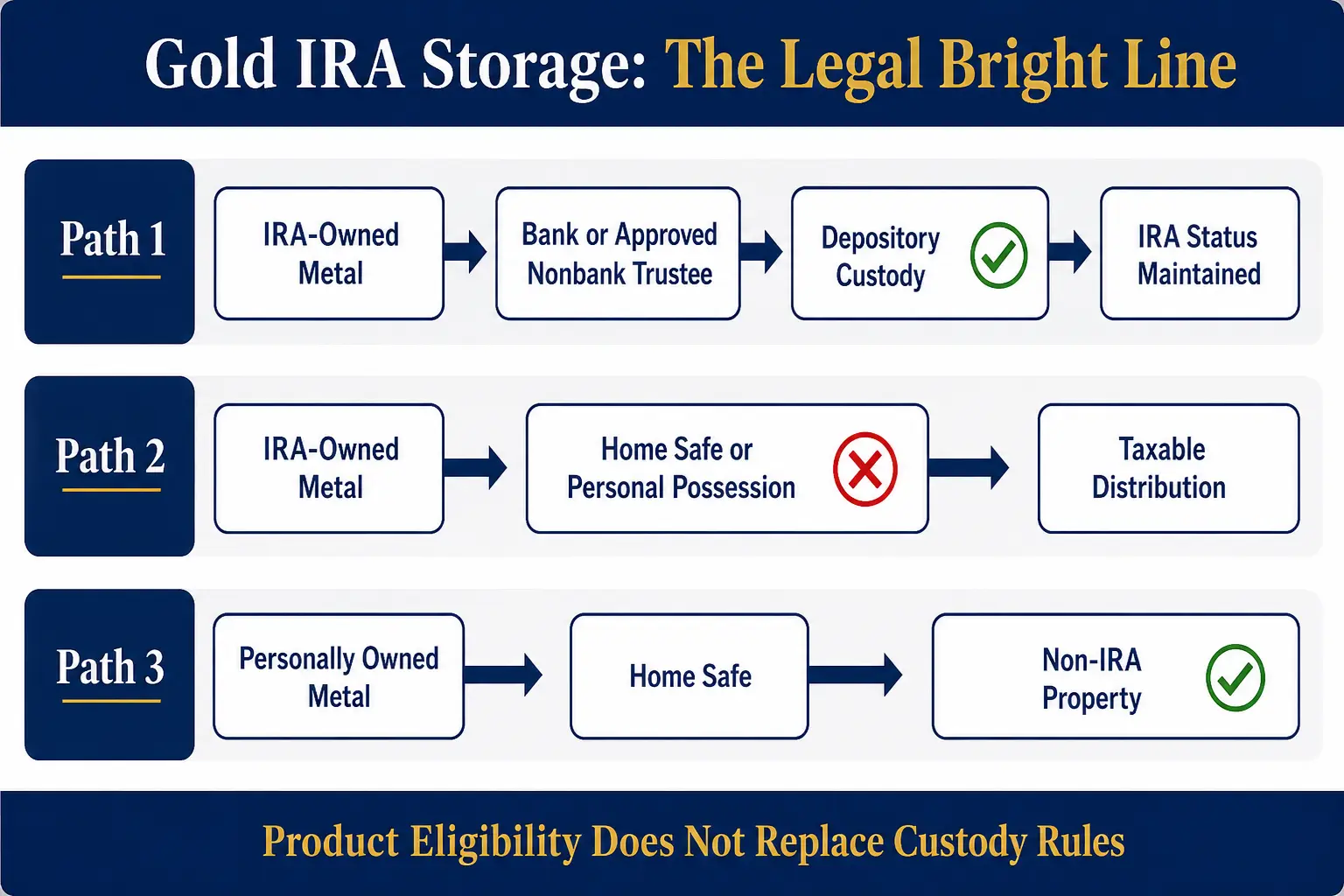
- The line is about ownership: IRA-owned metal must stay with a bank or IRS-approved nonbank trustee; personally owned metal can go in a home safe.
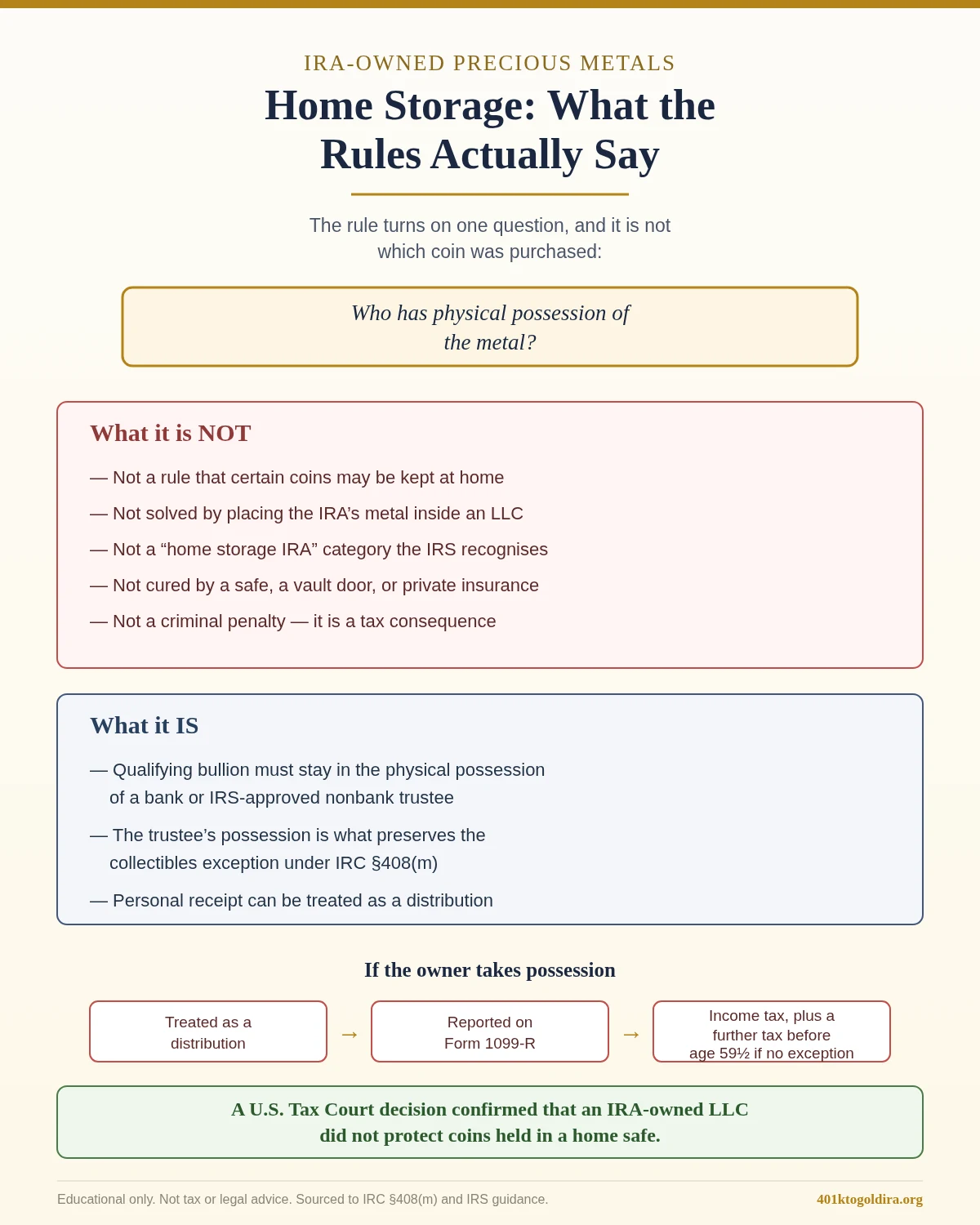
- Home possession of IRA metal is treated as a distribution — taxed as ordinary income, with a possible 10% early-distribution tax before age 59½.
- McNulty is the cautionary precedent: an IRA-owned LLC and "IRA-eligible" coin labels did not make home storage safe.
- "IRA eligible" describes the product, not a right to keep it personally. The custody rule still applies.
- A home safe is legitimate for non-IRA bullion bought with personal money — just not as a substitute for IRA custody.
What Is the Depository vs Home Safe Gold IRA Legality Line?
The practical rule has three parts. IRA-owned metal must be held through a bank or IRS-approved nonbank trustee or custodian. Personally owned metal may be kept in personal possession, including a home safe, subject to ordinary security, insurance, tax, and recordkeeping concerns; for the broader cost, liquidity and tax-wrapper comparison, see Gold IRA vs physical gold. IRA metal moved into personal possession can be treated as a distribution and included in taxable income; an additional early-distribution tax may also apply when the owner is under age 59½ and no exception applies (Internal Revenue Service; Cornell Legal Information Institute).
A home safe can be used for personally owned bullion that sits outside an IRA. That is a different ownership structure. Personal metal does not receive IRA tax treatment, and it is not governed by the IRA custody exception in Internal Revenue Code Section 408(m). This article focuses only on that legal choice. The site's full Gold IRA storage legality matrix covers other arrangements in greater depth.
Can Gold IRA Metal Be Kept in a Home Safe?
No, not while the metal remains inside the IRA. The IRS states that gold and other bullion are generally collectibles under the IRA rules, as explained in the guide to how a precious metals IRA works. Certain highly refined bullion is excluded from the collectible category only when it is kept in the physical possession of a bank or an IRS-approved nonbank trustee, and the same custody rule applies to an indirect purchase through an IRA-owned limited liability company (Internal Revenue Service).
Internal Revenue Code Section 408(m) provides the statutory basis. It excludes qualifying gold, silver, platinum, and palladium bullion from the collectible definition only when the bullion is in the physical possession of a trustee described in Section 408(a) (Cornell Legal Information Institute). That means an eligible gold bar does not remain IRA-compliant based only on its purity. The product must qualify, and the IRA must maintain independent custody. A home safe controlled by the IRA owner does not provide that custody. Private gold ownership is lawful, but personal possession and IRA ownership cannot be combined in that manner.
What Does the IRS Require for IRA Metal Custody?
The legal structure begins with the IRA trustee or custodian. Section 408(a) requires an IRA trust to be created or organized in the United States for the exclusive benefit of the owner or beneficiaries, with a bank or another person approved by the Treasury acting as trustee. Section 408(h) allows custodial accounts to receive similar treatment when the custodian is a bank or other approved person (Cornell Legal Information Institute). The IRS keeps a current list of entities approved under Treasury Regulation Section 1.408-2(e) to serve as nonbank trustees or custodians, and states that entities can be added or removed as approvals change (Internal Revenue Service).
Is a Depository Itself "IRS Approved"?
That phrase needs care. The IRS page identifies approved nonbank trustees and custodians. It does not publish a separate general list of vault buildings called "depositories used under a trustee's custody arrangements." In ordinary industry language, a "depository under the trustee's control" usually means a vault facility used within an arrangement controlled by a qualifying bank, trustee, or custodian. The written account documents should name the IRA trustee or custodian, the vault or depository where the metal will be held, the party responsible for custody records, the type of storage, the insurance arrangement, and the process for purchases, sales, transfers, and distributions. The CFTC and FINRA state that metals in a self-directed IRA must be held by the IRA trustee or custodian, and tell customers to review account statements and confirm that the bullion shown was actually purchased (Commodity Futures Trading Commission and FINRA). A dealer, custodian, and depository may be different companies: a dealer sells the metal, a custodian administers the IRA, and a depository provides vaulting under the custody arrangement. The site's new U.S. Gold IRA depository directory records what public sources say about several of these operators.
What Did the McNulty Tax Court Decision Establish?
The McNulty case is the leading published warning about a checkbook-LLC arrangement combined with home possession. Donna McNulty established a self-directed IRA that became the sole owner of an LLC. The LLC used IRA funds to purchase American Eagle coins, which were shipped to the McNulty residence and placed in a home safe (Journal of Accountancy). The structure had been marketed as allowing American Eagle coins to remain inside an IRA while stored at home if the coins were titled to the LLC. The Tax Court rejected that result, holding that McNulty's physical possession gave her complete control over the coins and caused taxable IRA distributions (Journal of Accountancy; The Tax Adviser).
The coin costs treated as distributions were $374,000 for 2015 and $37,380 for 2016, for a combined $411,380. The Journal of Accountancy reported IRS deficiency determinations of $250,558 and $18,094 for those years before the court proceedings (Journal of Accountancy). The court's key point was control: an IRA owner may direct investments, but the owner loses the IRA benefits when the owner has unfettered control over the assets. The independent trustee or custodian must maintain custody, records, and oversight (The Tax Adviser). Customers should speak to a financial or tax advisor before making decisions involving possession, distributions, rollovers, or IRA assets. Goldco does not offer tax or legal advice.
Did the Case Apply Only to Bullion Bars?
No. The McNulty assets included American Eagle coins. McNulty argued that the trustee-possession language for bullion did not apply to those coins. The Tax Court rejected the idea that the coin exception displaced the basic trustee and custodian requirements of Section 408(a) (Journal of Accountancy; The Tax Adviser). "IRA eligible" describes the product; it does not grant the owner a right to keep the product personally.
Why Are Home-Storage IRA or Checkbook-LLC Schemes Risky?
The risk comes from confusing investment control with physical custody. A self-directed IRA allows broader investment choices than many standard brokerage IRAs. It does not give the owner unrestricted personal control over IRA property. The IRS expressly says the bank-or-approved-nonbank-trustee possession rule applies when an IRA-owned LLC buys bullion (Internal Revenue Service). The McNulty decision shows that a formal chain of ownership does not solve the problem when the owner has direct physical control.
Marketing claims become especially risky when they rely on phrases such as "private home storage IRA," "checkbook control means personal custody," "the LLC owns it, so the home safe is allowed," "American Eagle coins are exempt from all custody rules," or "no third-party custodian is needed after the LLC purchase." Those statements should not be accepted without independent legal and tax review, because the account owner carries the tax exposure if the structure fails. The CFTC and FINRA warn that self-directed precious-metals IRAs can involve storage, insurance, administration, taxes, and penalties, and that some fraudulent dealers have charged storage and insurance fees for metal that did not exist (Commodity Futures Trading Commission and FINRA).
What Is a Home Safe Legitimately Good For?
A home safe can store bullion that is owned personally and held outside an IRA. That personal bullion is not an IRA asset. Home possession can provide immediate physical access and avoids an external storage contract. It also places security, documentation, and insurance responsibility on the owner. No universal statement can confirm that a standard homeowners policy covers the full value of bullion; coverage depends on the policy, exclusions, sublimits, documentation, safe specifications, and any separate endorsement or specialty policy.
A personally owned coin can be placed in a home safe without violating the IRA custody rule because it is not inside the IRA. The same coin cannot be treated as both personally controlled property and a custodial IRA asset. A saver who wants personal access should compare two clean choices: buy personally owned bullion with non-IRA money and accept the personal tax, security, and insurance rules; or hold qualifying bullion inside an IRA and keep it under the required trustee or custodian arrangement. Trying to merge those choices creates the legal risk. Past performance does not guarantee future results.
How Does a Depository Compare With a Home Safe?
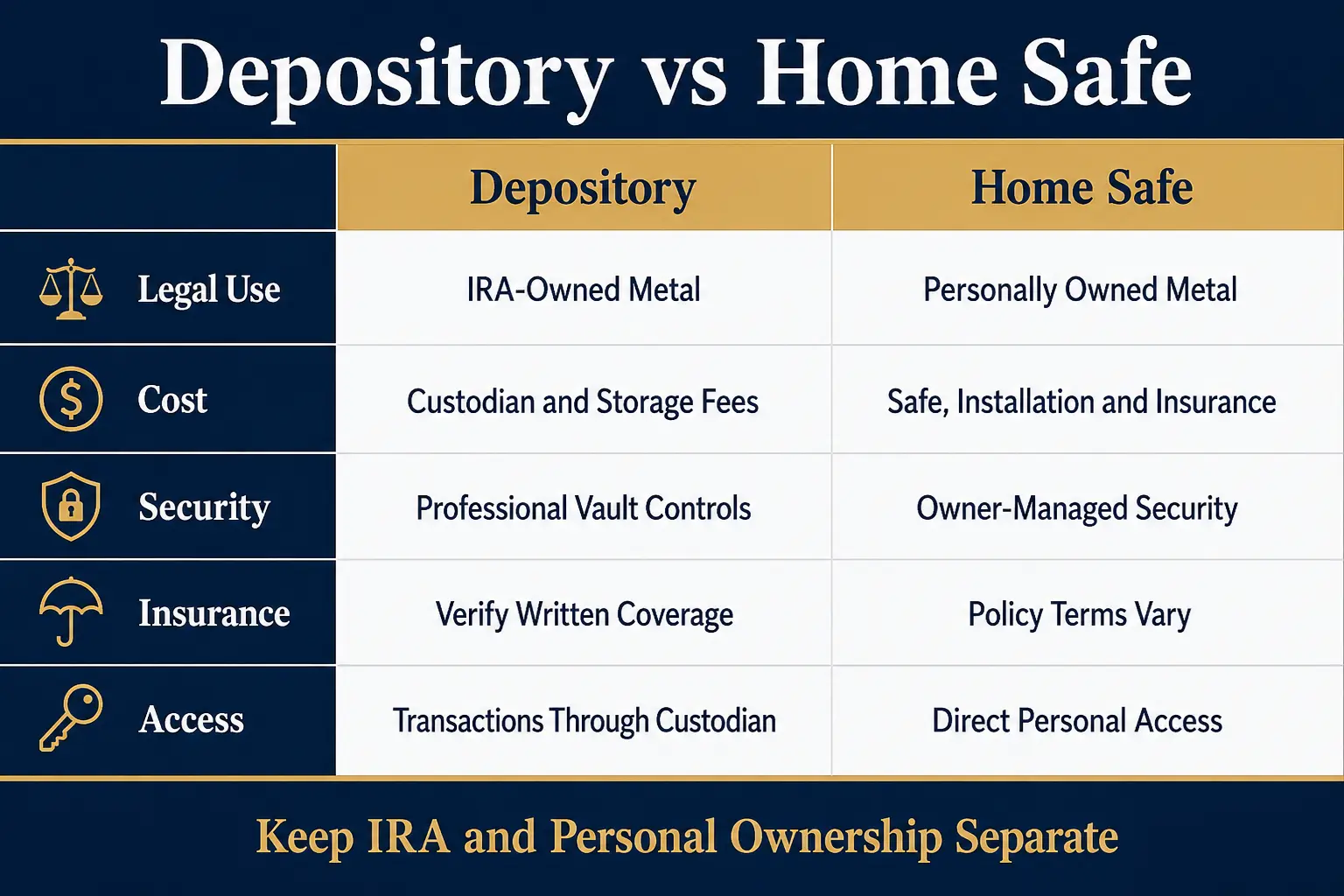
The comparison changes depending on who owns the metal. On legality, qualifying IRA bullion can remain inside the account when custody is maintained through a bank or approved nonbank trustee or custodian, while a home safe is appropriate for personally owned, non-IRA bullion and is not an accepted substitute for independent IRA custody (Internal Revenue Service; Journal of Accountancy).
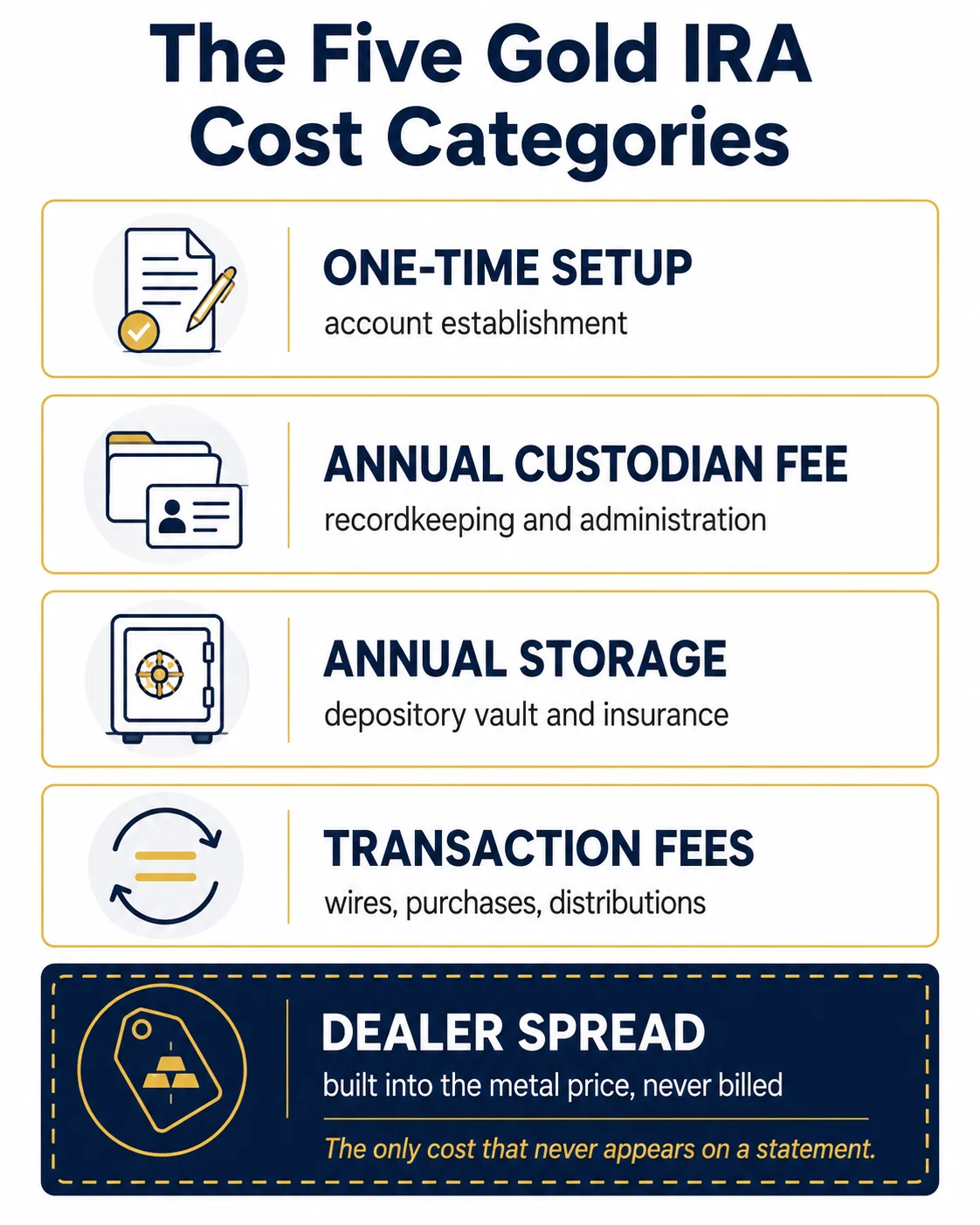
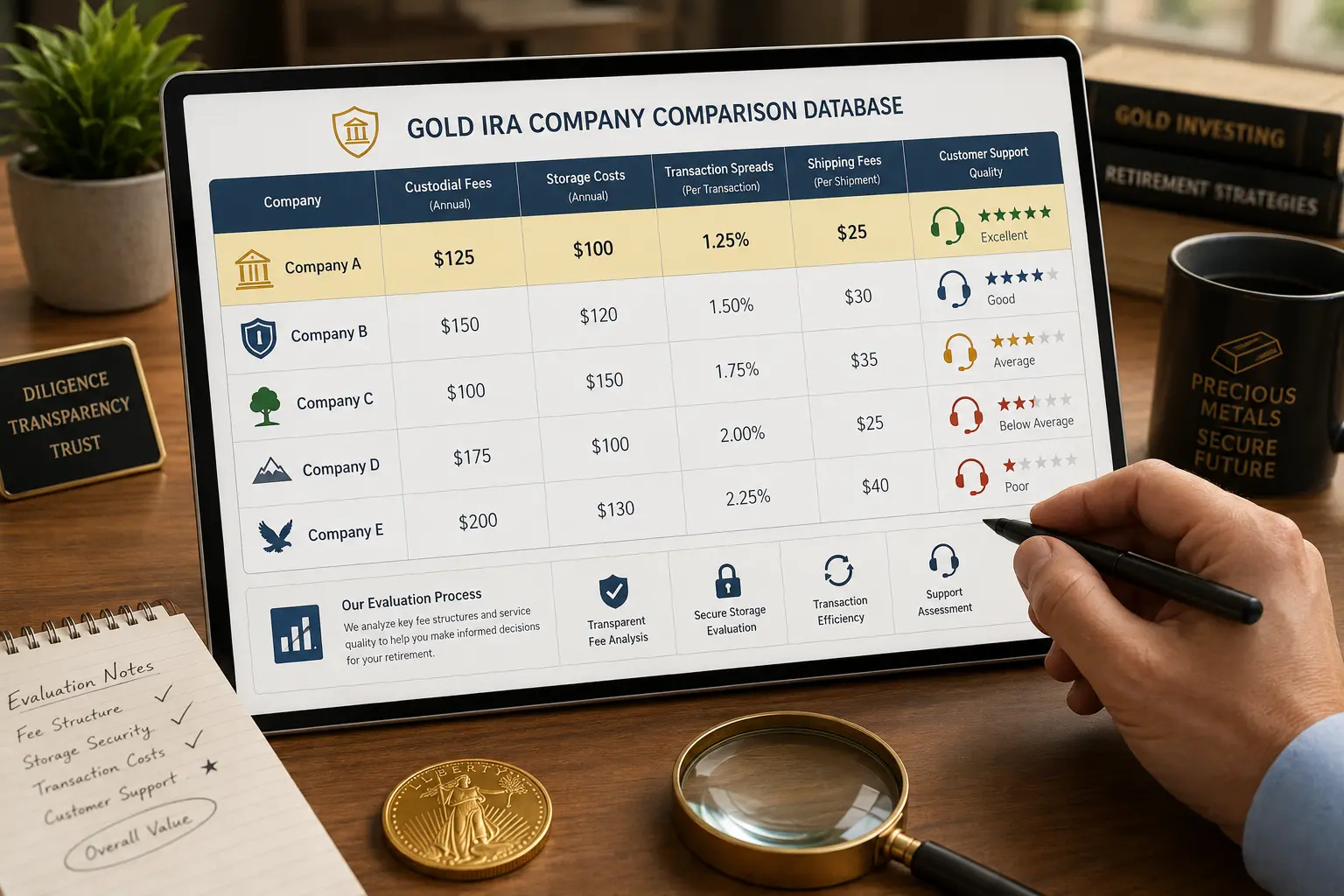
On cost, an IRA depository arrangement may include custodian administration, storage, insurance, shipping, transaction, and distribution charges, while a home safe avoids annual depository billing but may involve the safe, installation, alarms, security systems, appraisal, and insurance. The Gold IRA storage fee calculator can organize provider-specific costs, and the hidden Gold IRA fee guide explains which written charges should be requested. On security, professional facilities may use controlled vault access, monitoring, inventory procedures, and independent audits, while a home safe depends on the safe, installation, building controls, alarms, and household practices. On insurance, depositories may maintain precious-metals or all-risk coverage that the owner should verify (insurer, limits, exclusions, deductibles, valuation, transport), while a home safe's coverage depends on the personal insurance contract. On access, the owner generally directs the custodian to sell, transfer, or distribute IRA metal, while personally owned bullion is directly accessible — and that convenience is exactly what conflicts with IRA ownership.
How Can an IRA Owner Verify an Approved Storage Arrangement?
Verification should begin with the trustee or custodian, not the dealer's advertising.
- Confirm the trustee or custodian. The legal name should match the IRA agreement and account statement. When it is not a bank, the IRS approved-nonbank-trustee page can be checked; the list changes as approvals are added, withdrawn, or revoked (Internal Revenue Service).
- Confirm the depository directly. Obtain the facility's name, location, contact details, and relationship with the custodian in writing.
- Confirm how title and records are maintained. The documents should show the metal is held for the IRA through the trustee or custodian, not personally by the account owner.
- Confirm insurance and audit terms. The written response should identify coverage, exclusions, valuation, audit procedures, and the treatment of metal in transit.
- Confirm storage type without rebuilding the full storage analysis. Segregated and commingled arrangements differ in cost and whether specific bars or coins are returned — see the Gold IRA storage options guide and the full storage legality matrix.
- Reject personal-delivery instructions. An IRA purchase should not be shipped to the account owner's residence for home storage. Any instruction that puts IRA metal under personal control should be stopped until a qualified tax or legal professional reviews the arrangement.
The Gold IRA decision quiz can help organize account-structure questions. It does not provide legal or tax advice.
What Are Common Questions About Depository vs Home Storage?
Can an IRA owner inspect metal at a depository?
Access policies vary by custodian and depository. Some facilities may allow scheduled inspections under controlled procedures. An inspection does not mean the IRA owner can take the metal home while preserving IRA status.
Can Gold IRA metal be stored in a bank safe-deposit box controlled by the owner?
Personal control is the central problem. The IRS requires custody through a bank or approved nonbank trustee, not merely a box located inside a bank building. A personally controlled safe-deposit box should not be assumed to satisfy the IRA rules (Internal Revenue Service; Cornell Legal Information Institute).
Does an IRA-owned LLC make home storage legal?
The IRS says the physical-possession rule also applies when an IRA-owned LLC buys bullion. McNulty shows that LLC title did not prevent taxation when the IRA owner held the coins at home (Internal Revenue Service; Journal of Accountancy).
Are American Eagle coins exempt from the custody requirement?
Certain American Eagle coins can qualify as permissible IRA investments, but product eligibility does not authorize personal home possession. The McNulty case involved American Eagle coins and still resulted in taxable distributions (Journal of Accountancy).
Is every depository arrangement automatically compliant?
No. The IRA must use a qualifying trustee or custodian, and the product, records, custody, and transaction procedures must comply. A depository name alone is not enough.
Can personally owned bullion be moved into an IRA later?
A direct contribution of personally held bullion should not be assumed to qualify as an IRA contribution. IRA funding and metal purchases must follow the custodian's process and the contribution or rollover rules.
Bottom Line
The depository-versus-home-safe question is mainly an ownership question. IRA-owned bullion must remain under the independent custody required by Section 408. A home safe controlled by the IRA owner does not provide that structure, and the McNulty decision shows that an LLC wrapper and coin labels do not overcome personal possession. A home safe remains a legitimate place to consider for personally owned, non-IRA bullion when security, insurance, and recordkeeping have been addressed. The clean approach is to keep the two forms of ownership separate: depository custody for metal inside the IRA, and personal custody for metal owned outside the IRA.
Sources
- Internal Revenue Service. Retirement Plans FAQs regarding IRAs · Investments in collectibles in individually directed qualified plan accounts.
- Internal Revenue Service. Approved nonbank trustees and custodians · Exceptions to tax on early distributions.
- Cornell Legal Information Institute. 26 U.S. Code § 408 — Individual retirement accounts.
- Journal of Accountancy. Gold coins in taxpayer's home were taxable IRA distributions (McNulty).
- The Tax Adviser. Taking possession of coins is a taxable distribution.
- Commodity Futures Trading Commission and FINRA. 10 things to know about precious-metals IRAs.
- Delaware Depository. Storage and transfer services.
- International Depository Services. Official site — services.
Reviewed and edited by Daniel M. — editor, 401kToGoldIRA.org. Educational only; sourced to the IRS, Cornell Law (IRC § 408), the Journal of Accountancy and The Tax Adviser (McNulty v. Commissioner), the CFTC/FINRA, and depository disclosures. Not legal, tax, or investment advice.